
Spring GraphQL Milestone One

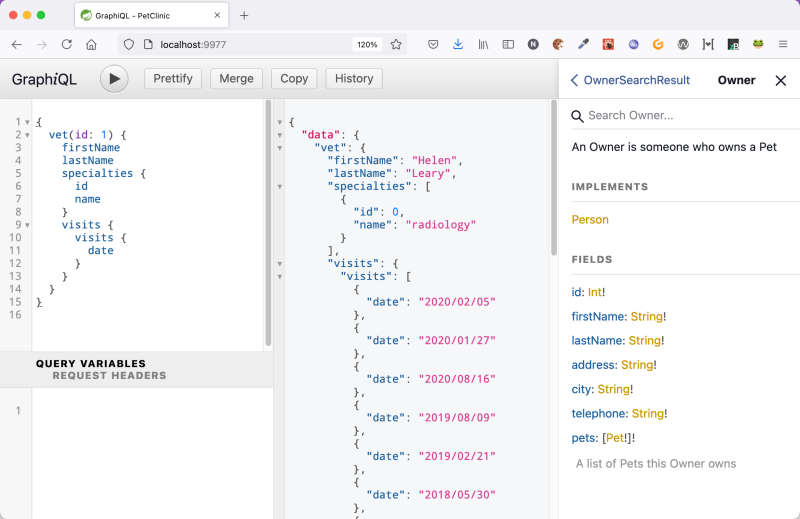
 A new library aims to unify all the previous approaches of accessing GraphQL from Spring. The Spring GraphQL project, which has reached its initial milestone towards a 1.0 release, integrates GraphQL, Java and Spring and was developed as a collaboration between both teams.

Until now the way you accessed GraphQL from Spring was through the standard GraphQL Java Spring project which at the minimum would expose a /graphql endpoint (something that as well as the transport agnostic, was missing from the original GraphQL Java library) in order to accept the GraphQL payloads over HTTP; or the newest counterpart, that of the Netflix DGS Framework (Domain Graph Service).


full article on i-programmer.info


Comments

Popular posts from this blog

Europe Gets Its Own LLM

  EuroLLM is a fully open-sourced large language model made in Europe and built to support all twenty-four official EU languages. While several European states have separately produced their own LLMs, such as Greece's "Meltemi" or the recent offering from Switzerland "Apertus", there was no solution that catered for the languages of all 24 states belonging to the EU block. The time has come for this status to change with the appearance of EuroLLM, a foundational model that supports them all. https://www.i-programmer.info/news/105-artificial-intelligence/18448-europe-gets-its-own-llm.html

Open Source Is Not Just About Software

  It's about infrastructure as well, something that although not attracting the limelight, is as important as the open source software it hosts. Today the stewards of the largest open source registries in the world have issued an open letter demanding urgent reform in how open source infrastructure is funded, maintained, and operated.  https://www.i-programmer.info/news/136-open-source/18334-open-source-is-not-just-about-software.html

The PaSh Project gives your POSIX script superpowers by utilizing parallelization in order to speed up execution times.

The PaSh Project gives your POSIX script superpowers by utilizing parallelization in order to speed up execution times. This leads to faster results for data scientists,  engineers,  biologists,  economists,  administrators,  and programmers. I remember the time when the saying was "Learn Perl so you don't have to learn the Shell and its hundreds of utilities". Fast forward some decades and the use of shell scripts still has not been eradicated. On the contrary, their use has increased due to the rise of containers, VM's, administering the cloud, and Linux itself. This also serves as a lesson to those who are quick to denounce technologies as 'dead'. There's a time where a new use case revitalizes an old technology. So what is meant by "Unix philosophy"?  full article on i-programmer: https://www.i-programmer.info/news/90-tools/14990-the-pash-project-advancing-the-unix-philosophy-one-step-further.html